Why is it important to record data (logging) when tuning a car?
28.03.2025When tuning a car, data logging is extremely important—it’s even more crucial than using a dyno. Logging the right data in the right way leads to precise fine-tuning and safe results. Based on the gathered information, we can ensure that everything is functioning properly and follows the logic set during the ECU tuning process.
What is data logging?
Imagine you’re on the operating table and the surgeon isn’t using equipment to monitor your vital signs. Gives you chills, right? You are in the same situation when tuning your car without monitoring the key data received from the engine.
In short, data logging is a way to understand what information the ECU receives from all engine systems and components within a specific range of RPM and load. Logging is extremely helpful in tuning a car! It can also be used for diagnostics and troubleshooting issues such as pressure loss, lean or rich fuel mixtures, detonation, closed throttle, etc.
When should we log data?
One of the most important things before starting to tune a car is to determine its current condition. If there are deviations from factory specifications, you must resolve these issues before making any changes to the ECU tuning!
Once we establish that the car is operating within factory specifications, we proceed with tuning. Logging data after every ECU modification is mandatory! It allows us to compare settings based on results.
Always log data, regardless of the degree of ECU modification!
What are the essential data parameters that must be logged?
Below, we have listed some of the most important data points related to performance and reliability. Some, like engine speed, must always be included in all logs.
- Engine speed [RPM] – (Engine revolutions per minute)
- Pedal position – (Throttle pedal position)
- Engine Load / Torque request – (Requested engine load/torque)
- Engine Load / Torque actual – (Actual engine load/torque)
- Throttle body position – (Throttle valve position)
- Mass air flow – (Measured air quantity from the MAF sensor)
- Intake manifold pressure – (Intake manifold pressure)
- Atmospheric pressure – (Atmospheric pressure)
- Boost pressure request – (Requested turbocharger pressure)
- Boost pressure actual – (Actual turbocharger pressure)
- Wastegate duty cycle – (Wastegate actuator duty cycle)
- Fuel pressure request – (Requested fuel pressure)
- Fuel pressure actual – (Actual fuel pressure)
- Fuel pump duty cycle – (Fuel pump duty cycle)
- Injection fuel quantity – (Injected fuel quantity (Diesel))
- Injection duration – (Injection duration (Diesel))
- Injection advance – (Injection timing advance (Diesel))
- Injectors corrections – (Injector corrections (Diesel))
- Ignition advance – (Ignition timing advance (Gasoline))
- Ignition retard – (Ignition timing retard (Gasoline))
- Ignition cylinder misfire – (Ignition misfire detection (Gasoline))
- Lambda / AFR request – (Requested air-fuel ratio)
- Lambda / AFR actual – (Actual air-fuel ratio)
- Short Term Fuel Trim – (Short-term fuel correction (Gasoline))
- Long Term Fuel Trim – (Long-term fuel correction (Gasoline))
- Intake air temperature – (Intake air temperature)
- Fuel temperature – (Fuel temperature)
- Water temperature – (Coolant temperature)
- Oil temperature – (Oil temperature)
- Exhaust gas temperature – (Exhaust gas temperature)
- Exhaust pressure – (Exhaust pressure)
Each of these parameters provides essential insights into how an engine is performing. To generate quality logs, you first need to be familiar with the software you will use. The more specialized this software is for your car brand, the better. The primary limitation in data logging is speed and the availability of certain channels/parameters.
Main types of logging:
- Idle logging. Every car with modified hardware should start with idle logging. Two tests should be conducted for 5–10 minutes each, one from a cold start and one from a warm start. The focus is on air-fuel mixture data and ignition misfires. If the check engine light comes on during the test, check for recorded Diagnostic Trouble Codes (DTCs).
- Constant speed logging. These tests are performed to gather data at cruising speed—when the car is in the highest gear and maintaining speed with minimal fuel consumption. Logging should be performed in a safe location or controlled environment (dyno).
- Variable RPM logging. These tests collect data at different RPM levels in 500-RPM steps while the engine is under load. While driving and logging, maintain steady RPMs for about 10 seconds at each step—2000 RPM, 2500 RPM, 3000 RPM, 3500 RPM, 4000 RPM. These steps can be recorded in a continuous log without stopping and starting a new recording for each RPM level. The primary goal of this test is to understand how the ECU adjusts fuel at specific RPMs, as well as other factors like engine load and ignition timing. Logging should be performed in a safe location or controlled environment (dyno).
- 100% throttle logging. These tests are conducted in third or fourth gear with 100% throttle from around 2000 to 6500 RPM for gasoline engines, or from around 1500 to 4500 RPM for diesel engines. If you notice unusual engine behavior (misfires, hesitation, strange noises, etc.), stop the test immediately and fix the issue before continuing! Logging should be performed in a safe location or controlled environment (dyno).
Logging rules:
- Never look at your laptop or smartphone screen while logging!!! If you are conducting tests on the road alone, start and stop logging only when the vehicle is stationary! Do not get distracted, as it could cost your life or someone else’s!
- Log as much data as possible. More data provides more accurate insights into how an engine operates. A single parameter change does not lead to a single result but affects multiple parameters in context. Often, a small change does not yield the desired result due to dependencies or may create an issue elsewhere.
- Log data at the highest possible frequency. This will increase the number of tests but significantly improve data quality. Consistency is key—perform tests in the same gear and on the same section of road.
- Always log engine speed and requested engine load in every test.
- Each log should be in a separate file to reduce size and make it easier to analyze.
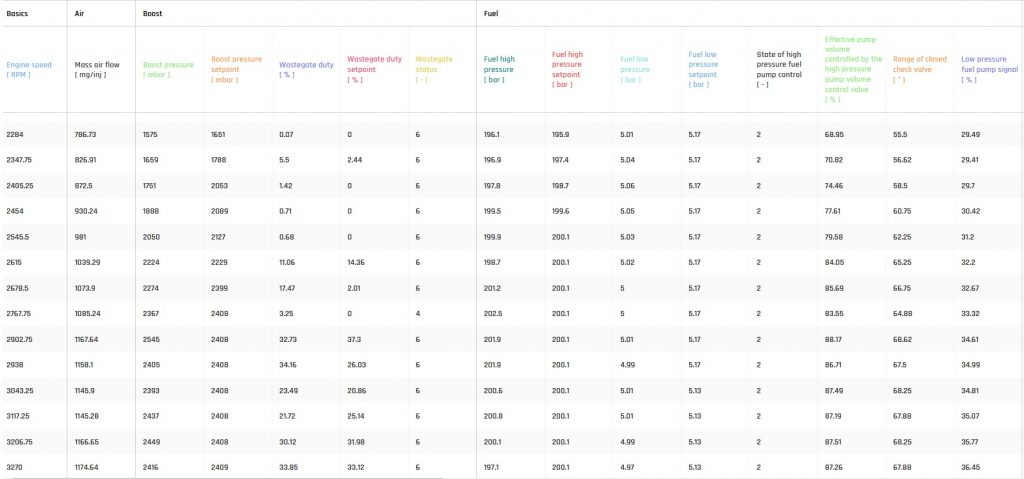
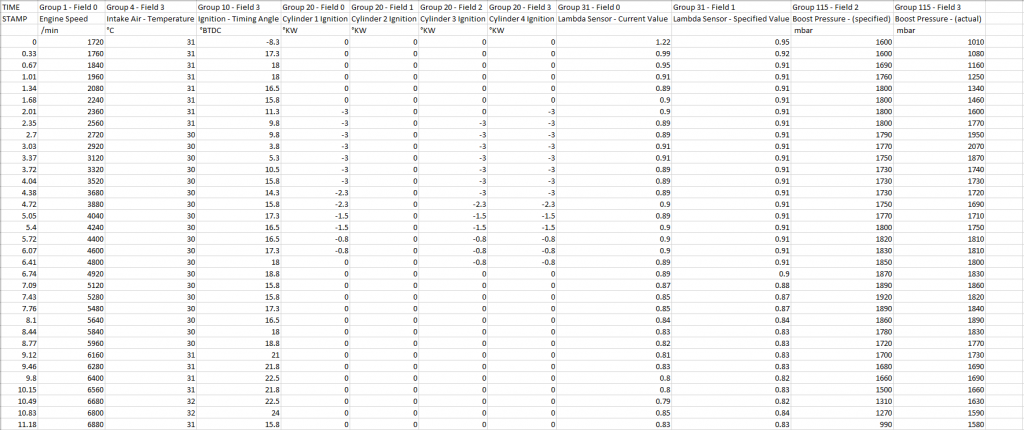
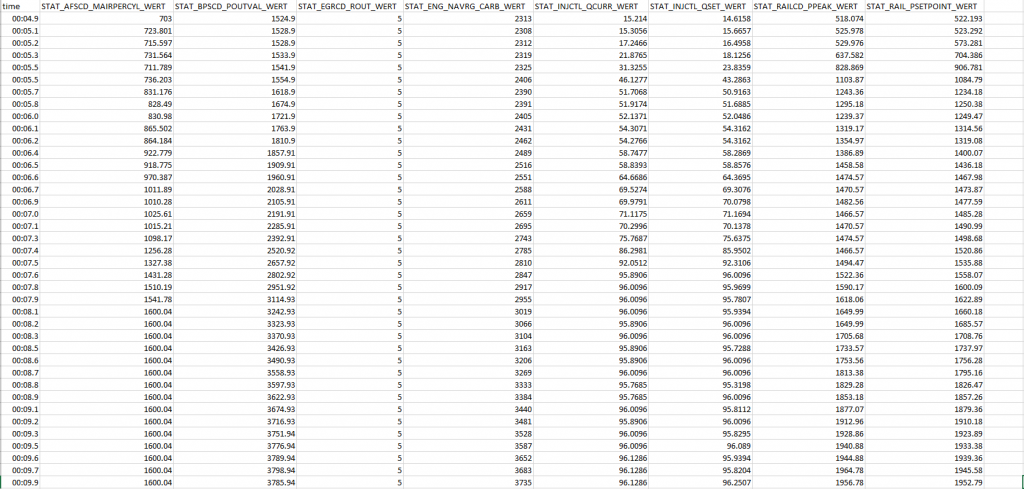
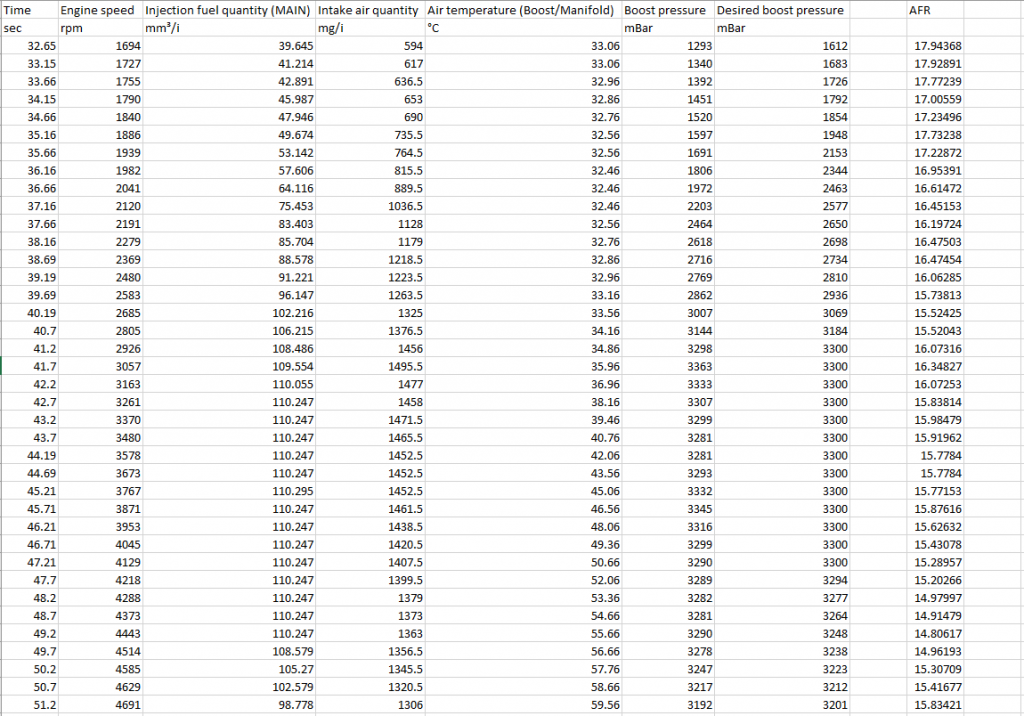
Example logs for different software:
VCDS (VAG):
Testo (BMW):
Multiecuscan (Fiat/Alfa Romeo):
OP-COM (Opel/Vauxhall):
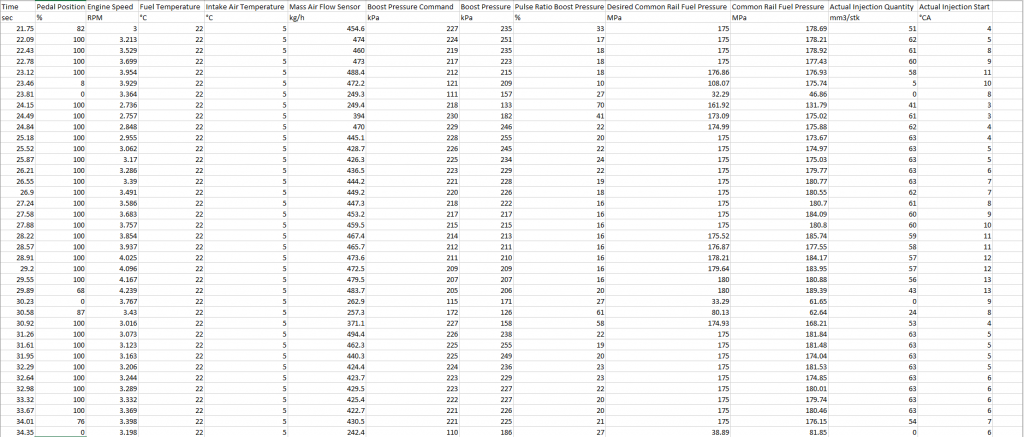
FAP (Citroen/Peugeot):
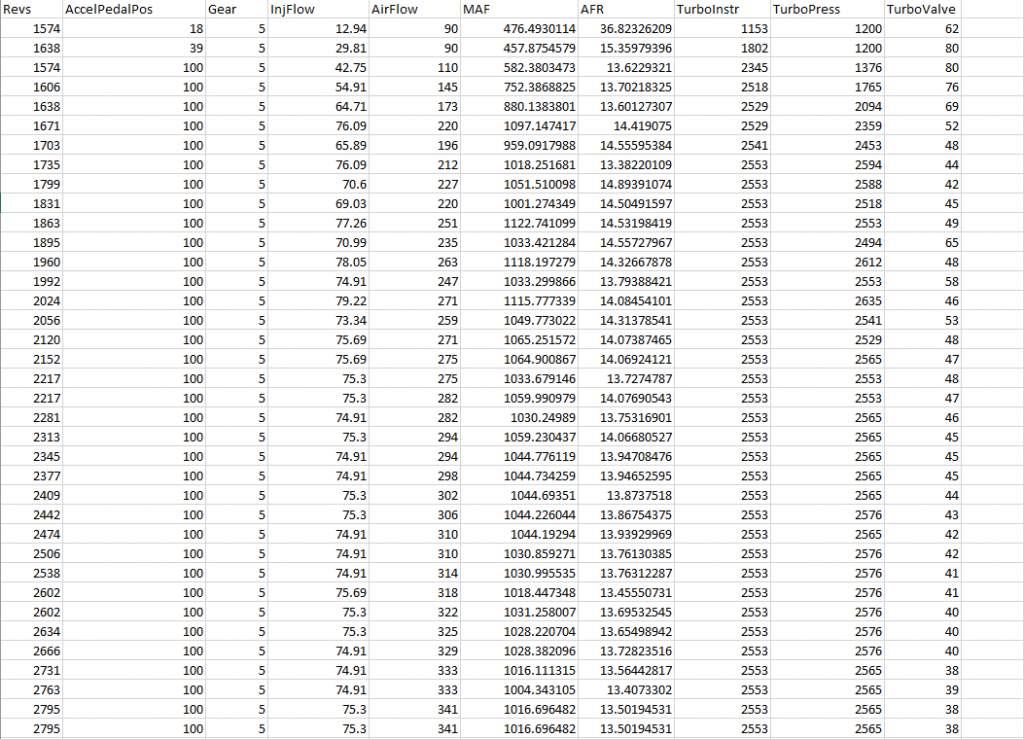
AutoTuner (Universal):